The 7 Pathways to Learning
Seven ways to invite curiosity, engagement, and confidence into the classroom, from preschool through high school.
One learning goal. More than one way in.
What If the Question Changed?
When a student struggles, it’s tempting to ask, “Why won’t they try harder?” My years as a special education teacher led me toward a different question: Under what conditions does this student become curious, involved, and willing to try?
A child who finds a worksheet difficult may become absorbed in a construction task. A teenager who rarely contributes to class discussion may engage deeply when a project connects to an issue they care about. The learning goal can stay the same while the invitation to learn changes.
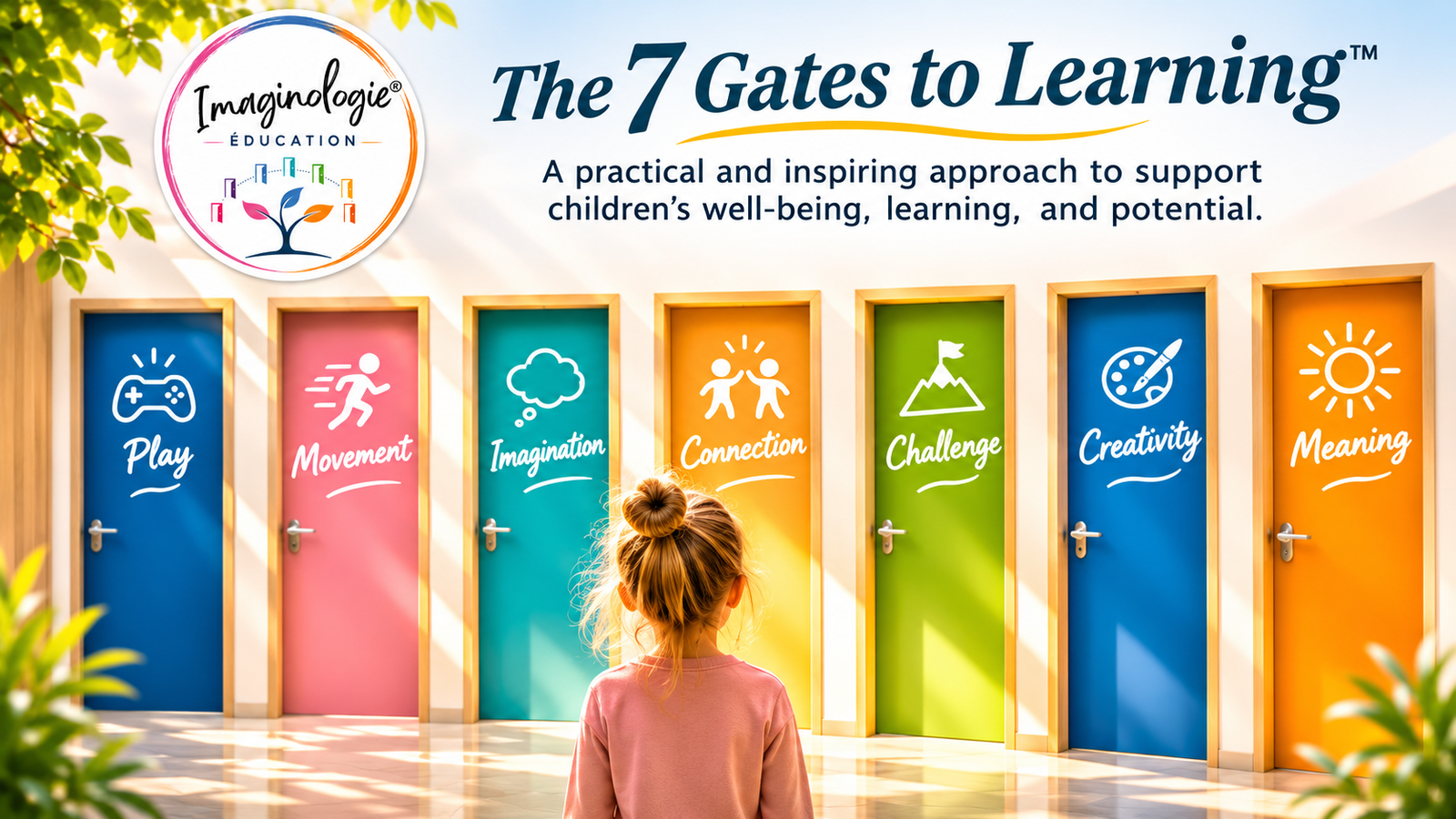
This idea inspired the Seven Pathways to Learning within Imaginologie® Education.
Pathways, Not Labels
The seven pathways are not seven types of students, a diagnostic tool, or a claim that children learn best when taught according to a fixed “learning style.” Any student can benefit from several pathways, depending on the task, context, and moment. The goal is to broaden teaching choices, not put learners into categories.
Use these pathways alongside clear instructional goals, appropriate scaffolding, formative assessment, and your school’s curriculum.
Explore the Seven Pathways
Each pathway includes two illustrative classroom applications. Adapt them to your subject, students, and grade level.
Play
Turn rehearsal into a low-stakes game.
Practice letter sounds with a matching game.
Use a short retrieval quiz with teams and constructive feedback.
Movement
Make ideas tangible through action.
Build number lines on the floor.
Use a gallery walk to compare historical arguments.
Challenge
Offer a meaningful goal with achievable steps.
Invite students to solve a three-piece pattern puzzle.
Break a complex project into milestones with visible progress.
Creation
Let learners make something that shows understanding.
Build a model of a plant’s life cycle.
Create a podcast, prototype, or evidence-based infographic.
Connection
Use dialogue, cooperation, and belonging.
Pair children to retell a story.
Use structured peer discussion to test competing interpretations.
Imagination
Invite students to picture, narrate, and explore possibilities.
Invent a character who travels through a story.
Write a future scenario to examine a scientific or civic question.
Meaning
Connect content to a purpose students can recognize.
Count objects needed for a class garden.
Apply statistics to a local issue students choose.
Your Free Classroom Activity Sheet
Bring the Seven Pathways to your classroom with a beautifully designed, printable one-page resource. Includes seven practical activities and a space to plan your own classroom experiment.
Download Your Free Classroom Activity Sheet (PDF)
Free PDF · US Letter (8.5 × 11 in) · No sign-up required
Try It Tomorrow: A 10-Minute Classroom Experiment
- Choose one objective. Keep the academic learning goal unchanged.
- Notice the barrier. Is the difficulty getting started, staying engaged, understanding instructions, or seeing a purpose?
- Open another pathway. Try movement plus connection, imagination plus creation, or challenge plus meaning.
- Check the learning. Ask students to demonstrate what they understood, not simply whether they enjoyed the activity.
- Reflect and adjust. Keep what helps; change what doesn’t.
Example: For vocabulary practice, students might act out terms (Movement), invent a brief dialogue (Imagination + Connection), or apply terms to a real-world question (Meaning). The assessment remains focused on accurate understanding.
Designed for Diverse US Classrooms
These flexible ideas can complement differentiated instruction, inclusive classrooms, and social-emotional learning. They are not a substitute for evidence-based instruction, individualized supports, IEP requirements, Section 504 accommodations, or school and district policies. Grade configurations and standards vary by state and district.
About Lou Ken
I’m Lou Ken, a former special education teacher from France and creator of Imaginologie® Education. My approach encourages educators to observe what helps learners engage, combine practical strategies, and make room for imagination without losing sight of academic goals.
These are adaptable educational ideas, not a validated seven-category assessment or US teacher credential.
Continue Exploring
Discover more ideas for attention, confidence, and engagement across school stages.